Quick answer: what is blockchain?
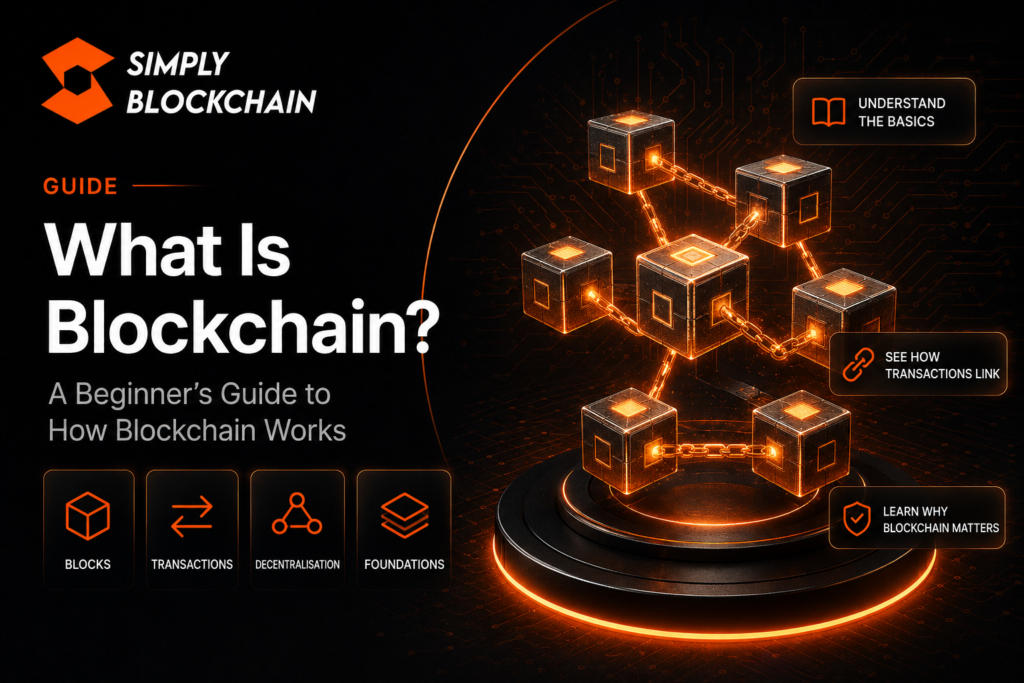
A blockchain is a shared digital record of transactions or other data that is maintained across a network of computers. Instead of one company keeping the only copy of the database, many participants can hold and verify copies according to the network’s rules.
New information is usually grouped into blocks. Each block contains a cryptographic reference to the block before it, which links the history together. On a well-designed blockchain, changing old records without the network noticing is deliberately difficult.
Blockchain is best known as the technology that allows cryptocurrencies such as Bitcoin and Ethereum to operate, but the basic idea is broader: multiple participants can share and verify the same record without relying on one central database owner.
Table of Contents
What is blockchain?
A blockchain is a type of distributed ledger. A ledger is simply a record of activity. Banks keep ledgers of account balances and payments; businesses keep ledgers of invoices and transactions. A blockchain applies that record-keeping idea to a computer network.
The important difference is that a blockchain can allow many independent computers, known as nodes, to maintain and check the record together. The exact rules vary between blockchains, but the network needs a method for deciding which new transactions are valid and what the latest accepted version of the ledger should be.
This is why blockchain is often associated with words such as decentralisation, consensus, cryptography and transparency. Those ideas work together, but they are not all identical. A blockchain can be more or less decentralised depending on how it is designed and who is allowed to participate.
For a beginner, it is useful to think of blockchain as a shared record book with rules. The network agrees on what can be added, participants can verify the history, and cryptography helps make tampering evident.
Why was blockchain created?
The most famous early use of blockchain technology was Bitcoin. Bitcoin was designed as a peer-to-peer electronic cash system that could transfer value without requiring a bank to maintain the central ledger.
That creates a difficult computer-science problem: if there is no central operator, how do thousands of computers agree on who owns what? How do they stop the same coins being spent twice? How do they decide which transactions happened first?
Bitcoin’s design combined several existing technologies and ideas, including digital signatures, cryptographic hashing, a distributed network and proof-of-work consensus, to maintain a shared transaction history. Later blockchain networks adapted the general model for different purposes.
Ethereum, for example, extended the idea so the blockchain could execute programmable smart contracts. Other networks make different trade-offs around speed, fees, decentralisation, privacy and how transactions are validated.
How does a blockchain work?
The details can become highly technical, but a beginner only needs to understand a basic flow:
- A user creates and signs a transaction.
- The transaction is broadcast to the blockchain network.
- Network participants check whether it follows the rules.
- Valid transactions are collected into a block or otherwise ordered by the protocol.
- The network reaches agreement, or consensus, on the accepted update.
- The new block is linked to the existing chain and the network’s state is updated.
The exact process differs between Bitcoin, Ethereum, Solana and other blockchains, so there is no single transaction flow that applies perfectly to every network. The important idea is that the network follows a predefined protocol for validating and ordering activity.
1. A transaction is created
Imagine you want to send cryptocurrency from your wallet to someone else. Your wallet prepares a transaction containing information such as the destination address and the amount being sent.
Your wallet then uses your private key to create a digital signature. That signature allows the network to verify that the transaction was authorised by the correct key without revealing the private key itself.
If you are still learning how wallets, addresses and private keys fit together, read our beginner’s guide to crypto wallets next.
2. The transaction reaches the network
The signed transaction is shared with nodes on the blockchain network. Nodes run software that understands the protocol and can check whether transactions follow its rules.
For a cryptocurrency transaction, checks may include whether the signature is valid, whether the sender has sufficient funds and whether the transaction format is acceptable.
3. Transactions are ordered
Blockchains need a consistent transaction history. On many networks, transactions are grouped into blocks. Those blocks are then placed in an agreed order.
A block can contain transaction data, a timestamp or other protocol information, and a cryptographic reference to an earlier block. The exact contents depend on the blockchain.
4. The network reaches consensus
Consensus is the process a distributed network uses to agree on valid updates to its shared state. Different blockchains use different consensus mechanisms.
Bitcoin uses proof of work. Ethereum uses proof of stake. Other networks use variations of proof of stake or different consensus designs entirely.
The purpose is not simply to make computers “vote”. A consensus mechanism defines the economic and technical rules that determine how blocks are proposed, validated and accepted, and how the network responds when participants disagree or behave dishonestly.
5. The blockchain is updated
Once a new block or state update is accepted, nodes update their copy of the ledger. Future blocks build on the accepted history.
Because blocks are cryptographically linked, altering older data can break those links. On established public blockchains, an attacker would also need to overcome the network’s consensus protections to make an alternative history accepted. That is why blockchains are often described as tamper-evident or tamper-resistant rather than magically impossible to change.
What is a block?
A block is a batch of information accepted into the blockchain’s history. In cryptocurrency networks, that information commonly includes transactions plus data required by the protocol.
Each block is connected to earlier blocks using cryptographic hashes or references. A hash is a fixed-size output produced from data by a cryptographic hash function. If the input data changes, the resulting hash changes.
This property makes hashes useful for linking blocks. If someone alters old block data, its hash changes and the links built from that value no longer match. The inconsistency can be detected by other participants.
It is worth noting that not every distributed ledger uses identical block structures, and different blockchain networks organise data in different ways. “Blocks linked into a chain” remains a useful beginner model, but the implementation varies.
What is a blockchain transaction?
A blockchain transaction is a request to change the state recorded by the network.
For Bitcoin, that might mean transferring value. On a programmable blockchain such as Ethereum, a transaction can also interact with a smart contract. Depending on the network, transactions might swap tokens, mint an NFT, vote in an on-chain system, provide liquidity or call another application function.
Transactions generally need to meet the network’s rules before they are accepted. They may also require a network fee. Later in the Simply Blockchain roadmap we will cover gas fees, swaps, slippage and bridges in more detail.
What are blockchain nodes?
A node is a computer running software that participates in a blockchain network. Different types of nodes can have different responsibilities.
Some maintain extensive copies of blockchain data and independently verify network rules. Others may provide specialised functions or store less information. Validators or miners perform additional roles in networks that use them for consensus.
The distribution of nodes is important because it reduces dependence on a single central server. If one node goes offline, the entire blockchain does not necessarily stop. Other participants can continue maintaining and sharing the network state.
However, simply having many nodes does not automatically make every blockchain equally decentralised. Decentralisation also depends on factors such as validator distribution, software diversity, governance, infrastructure concentration and who can realistically participate.
What does decentralised mean in blockchain?
Decentralised generally means that control or operation is spread across multiple independent participants rather than being concentrated entirely in one organisation.
A traditional online service might rely on a company’s central database. The company decides who can access it, can change records and controls the servers that keep it running.
A public blockchain can distribute verification and record-keeping across many participants. Users can often independently check transactions without trusting one company’s internal database.
Decentralisation comes with trade-offs. Coordinating many independent participants can be slower or more expensive than updating a conventional central database. Different blockchain projects make different choices about this balance.
What is blockchain consensus?
Consensus is how participants agree on the accepted state and history of a blockchain despite not relying on one central administrator.
Proof of work
In proof-of-work systems such as Bitcoin, miners compete to perform computational work. The process helps determine who can add the next block and makes rewriting the chain economically costly.
Proof of work has proven capable of securing a large permissionless network, but it also requires substantial computing resources and energy.
Proof of stake
In proof-of-stake systems, validators commit cryptocurrency as stake and participate in proposing or validating blocks according to the network’s protocol. Economic penalties can apply to certain dishonest behaviour.
Proof-of-stake designs can avoid the mining process used by proof of work, but they introduce their own technical and economic considerations.
You do not need to understand every consensus algorithm to start using crypto. What matters initially is understanding that a blockchain needs a method for independent participants to agree on valid updates.
Is blockchain the same as Bitcoin?
No. Bitcoin is a cryptocurrency and network; blockchain is the underlying type of ledger technology Bitcoin uses.
Bitcoin was the application that made blockchain widely known, but blockchain technology is not limited to Bitcoin. Ethereum, Solana and many other networks have their own blockchains and rules.
It is similar to the distinction between the internet and a particular website. A website may use internet infrastructure, but the internet is not that one website. In the same way, Bitcoin uses a blockchain, but blockchain is a broader concept.
Blockchain vs cryptocurrency: what is the difference?
Blockchain is the infrastructure or ledger system. Cryptocurrency is a digital asset that can exist and move according to the rules of a blockchain network.
Cryptocurrency often has an important role in securing or operating the network. It may be used to pay transaction fees, reward validators or miners, provide economic incentives or interact with applications.
Not every blockchain works in exactly the same way, and not every blockchain use case needs to resemble a public cryptocurrency network. But in the crypto ecosystem, the two concepts are closely connected.
What are smart contracts?
A smart contract is code deployed to a blockchain that can execute according to predefined rules. The word “contract” can be misleading because smart contracts are not automatically legal contracts; they are programs that operate on a blockchain.
Smart contracts make it possible to build decentralised applications and protocols. For example, a decentralised exchange can use smart contracts to manage swaps, while a lending protocol can use them to manage deposits, borrowing and repayments.
This programmability is one of the reasons networks such as Ethereum became platforms rather than simply systems for transferring a native cryptocurrency.
Smart contracts introduce additional risk. Bugs, malicious code or unexpected interactions can lead to losses, which is why connecting a wallet to an unfamiliar application should never be treated as risk-free.
Public vs private blockchains
Not every blockchain is open to everyone.
Public or permissionless blockchains
Public blockchains such as Bitcoin and Ethereum allow broad participation. Anyone can generally read the public ledger, submit valid transactions and run software to verify the network, subject to the protocol’s requirements.
These networks are designed to operate among participants who do not necessarily know or trust each other.
Private or permissioned blockchains
Permissioned blockchains restrict who can participate in some roles. A business consortium, for example, might use a shared ledger where only approved organisations can validate transactions.
Permissioned systems can offer more control over access and governance, but they are not the same trust model as an open public network.
What can blockchain be used for?
Cryptocurrency remains the most visible blockchain use case, but the technology can support other forms of shared digital ownership and record-keeping.
Common blockchain applications include:
- Digital currencies: transferring and recording cryptocurrency ownership.
- Smart-contract applications: decentralised exchanges, lending protocols and other on-chain services.
- Tokenisation: representing digital or real-world rights and assets as blockchain tokens.
- NFTs: recording ownership or control of unique blockchain tokens.
- Digital identity and credentials: systems that use blockchain components to verify claims or records.
- Shared business records: situations where several organisations need a common, auditable ledger.
Blockchain is not automatically the best technology for every database problem. If one trusted organisation can efficiently maintain a conventional database, a blockchain may add unnecessary complexity. Its strengths become more relevant when multiple parties need a shared record and reducing reliance on one central administrator is valuable.
Is blockchain secure?
Blockchain networks can provide strong integrity and verification properties, but saying “blockchain is secure” is too broad.
The ledger may be resistant to tampering while individual users still lose funds through phishing, malware, stolen seed phrases, fake websites, compromised exchanges or malicious smart contracts.
Security also varies between networks. A small blockchain with weak economic security or highly concentrated validation may be easier to disrupt than a mature network with stronger protections.
For users, one of the most important lessons is that blockchain security does not remove personal security responsibility. A valid transaction authorised by a stolen private key may still look completely legitimate to the network.
That is why Simply Blockchain’s beginner roadmap puts security before advanced on-chain activity.
Can blockchain transactions be reversed?
Usually, confirmed blockchain transactions are designed to be difficult or impossible for an ordinary user to reverse unilaterally. There is normally no chargeback department built into a permissionless blockchain.
That finality is useful because participants can rely on accepted records, but it also means mistakes can be costly. Sending funds to the wrong address, using the wrong network or approving a malicious transaction may not have a simple recovery process.
Some applications, custodians or protocols can add their own recovery or administrative features on top, so “all blockchain transactions are irreversible” is too absolute. For a beginner, the safe rule is to assume that an on-chain transfer may be final and check the details before signing.
Are blockchains anonymous?
Many public blockchains are better described as pseudonymous rather than anonymous.
Wallet addresses do not necessarily display a person’s real name, but transactions and balances can be publicly visible. If an address becomes connected to someone’s identity, other activity associated with that address may also become easier to analyse.
Privacy varies significantly between blockchains and applications. Never assume that using cryptocurrency automatically makes your activity private.
What are blockchain explorers?
A blockchain explorer is a website or application that lets you inspect public blockchain data in a human-readable form.
You can usually search for a wallet address, transaction hash, block number or token and see information recorded by the network. Explorers are useful for checking whether a transaction has been confirmed, verifying the address involved and understanding what happened on-chain.
Learning to read a block explorer is one of the most useful practical skills for a new crypto user because it lets you verify activity independently instead of relying entirely on what a wallet or exchange interface tells you.
What are the advantages of blockchain?
The potential benefits depend on the network and use case, but common advantages include:
- Shared verification: participants can independently check the ledger rather than relying only on one organisation’s records.
- Tamper evidence: cryptographic links and consensus rules make unauthorised historical changes detectable and potentially very difficult.
- Resilience: distributed networks do not necessarily depend on one server or operator remaining online.
- Programmability: smart-contract blockchains can run applications and automate on-chain rules.
- Open access: permissionless networks can let users participate without asking a central operator for an account.
What are the disadvantages and risks of blockchain?
Blockchain also introduces real limitations and risks:
- Transactions can be unforgiving: mistakes may be difficult to reverse.
- Fees can vary: network demand can make some transactions expensive.
- Scalability trade-offs: decentralised networks may process activity differently or less efficiently than centralised systems.
- Smart-contract risk: code can contain bugs or malicious logic.
- User security: phishing and poor key management can cause permanent losses.
- Complexity: networks, wallets, addresses, fees and approvals create a learning curve.
- Transparency can reduce privacy: public ledgers can expose transaction history.
A trustworthy introduction to blockchain should explain both the advantages and the trade-offs. The technology can be extremely useful without being the correct solution to every problem.
Blockchain explained with a simple example
Imagine a group of people keeping a shared spreadsheet of payments. Instead of one person owning the master file, everyone has a copy.
Whenever someone proposes a new payment, the group checks it against agreed rules. Accepted payments are added to the shared history. Each new batch is linked to the previous history in a way that makes later tampering obvious.
If one person edits their local copy and claims they suddenly own more money, everyone else’s verified copies disagree with them. The network follows its consensus rules rather than accepting that one altered record.
A real blockchain is far more sophisticated than a shared spreadsheet, but this analogy captures the central idea: a shared record whose participants can independently verify the history.
Frequently asked questions about blockchain
Who owns a blockchain?
There is no single answer. A public blockchain can be operated by a distributed network of users, node operators, validators or miners, with software rules and governance spread across different participants. A private blockchain may be controlled by one organisation or a known group of organisations.
Where is a blockchain stored?
Copies of blockchain data can be stored across many computers running network software. Different nodes may store different amounts of data depending on their role and configuration.
Can a blockchain be hacked?
Blockchain systems can be attacked, but “hacked” can mean many things. An attacker might target a user’s wallet, an exchange, a smart contract, a bridge or the blockchain’s consensus itself. Security depends on what part of the system is being discussed.
Does every cryptocurrency have its own blockchain?
No. Some cryptocurrencies are native assets of their own blockchain, while many tokens are created on an existing blockchain such as Ethereum or Solana.
Do I need to understand blockchain before buying crypto?
You do not need to understand the mathematics or programming, but knowing the basics can help you avoid mistakes. Understanding wallets, networks, transaction finality and fees makes it easier to recognise what is happening when you buy, send or use cryptocurrency.
Is blockchain only useful for crypto?
No, but cryptocurrency is the most prominent public use of blockchain technology. Other applications include shared records, tokenisation, digital credentials and systems where multiple parties need a verifiable ledger.
What is the difference between a blockchain and a database?
A blockchain is a type of data system designed around shared verification, cryptographic linking and consensus between participants. A conventional database is usually controlled by an administrator who can update records directly. Traditional databases are often faster and simpler when a trusted central operator is appropriate.
What should a beginner learn after blockchain?
Once you understand the basic idea of blockchain, the next step is learning how you actually interact with one.
That means understanding crypto wallets, wallet addresses, private keys and seed phrases. These concepts turn blockchain from an abstract technology into something you can use safely.
Next guide: What Is a Crypto Wallet? A Beginner’s Guide to How Wallets Work.
You can also follow the complete Simply Blockchain Start Here roadmap to work through the beginner topics in order.
Trusted sources and further reading
If you want to go deeper into the technical foundations, use primary or authoritative sources rather than relying on social-media explanations alone:
Educational disclaimer
This guide is for educational purposes only and is not financial, investment, legal or tax advice. Cryptocurrency and blockchain applications can involve significant risk. Always verify important information, use official links and understand what you are signing before committing funds or connecting a wallet.
