Quick answer: what are crypto bridges?
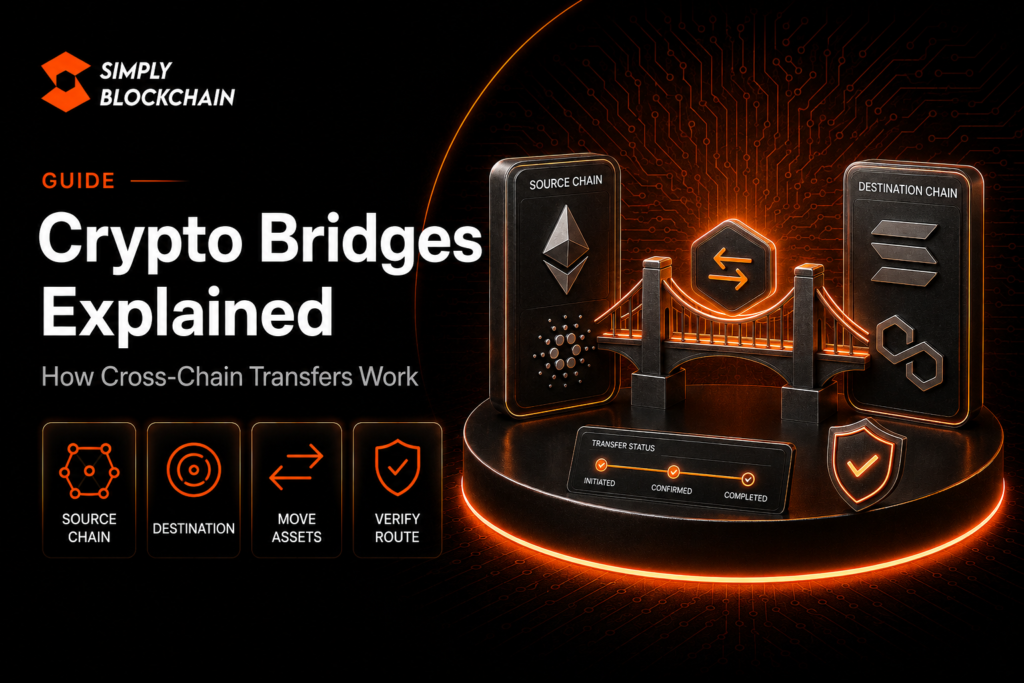
Crypto bridges are systems that connect separate blockchain networks so assets, messages or data can be represented or used across chains. They exist because blockchains do not naturally share one common state: an asset on Ethereum cannot simply appear on another network without some mechanism proving, locking, burning, minting or otherwise accounting for the cross-chain movement.
A bridge may make the experience look like a transfer, but the underlying asset is not necessarily travelling between chains in the same way a bank balance moves between accounts. Different bridge designs use different mechanisms and introduce different security assumptions.
For the broader beginner context, read our Crypto Swaps, Gas Fees, Slippage & Bridges pillar. This guide focuses on what bridges are and how they work.
On this page
Why do blockchains need bridges?
Each blockchain operates according to its own consensus rules and maintains its own state. Ethereum’s official bridge documentation describes blockchains as siloed environments that do not naturally communicate with one another.
Bridges create a route between those environments. Depending on the system, they can enable token transfers, cross-chain messages or more complex smart-contract interactions.
This is especially important in a multi-chain ecosystem where users may want to move assets between Ethereum, layer-2 networks and other chains to access different applications, fees or liquidity.
Do tokens actually move from one blockchain to another?
Not always in a literal sense. A common design locks an asset on the source chain and creates or releases a corresponding representation on the destination chain. Other designs burn an asset on one side and mint on the other, or use liquidity providers and other mechanisms to fulfil the transfer.
Ethereum’s bridge documentation highlights three broad mechanisms: lock and mint, burn and mint, and atomic-swap style approaches.
The user experience can therefore look like “send Token X from Chain A to Chain B,” while the protocol may actually be changing which representation of that value you control.
What is a bridged or wrapped asset?
A bridged asset is a representation of value on a destination chain that depends on a cross-chain mechanism. For example, an original token may be locked on one network while a corresponding wrapped or bridged token is minted elsewhere.
This introduces an additional dependency: the value of the bridged representation can rely on the security and solvency of the bridge mechanism as well as the underlying blockchains.
Do not assume two tokens with the same ticker on two chains are automatically interchangeable. Always check the contract address and whether the destination application supports the exact version you will receive.
Trusted versus trust-minimised bridges
Bridge designs differ in who or what verifies cross-chain messages.
- Trusted bridges may depend on an external operator, federation, validator set or custody arrangement.
- Trust-minimised designs try to rely more directly on the security of the connected chains, cryptographic proofs or protocol-level mechanisms.
There is no single perfect design. Ethereum’s bridge documentation explicitly frames bridge design as a series of trade-offs involving security, convenience, connectivity and cost.
What are the main risks of crypto bridges?
Smart-contract risk
A bug in the bridge contracts can expose locked assets or allow invalid cross-chain messages.
Validator or key compromise
If a bridge relies on a set of keys or external validators, compromising enough of them can undermine the bridge. Chainlink’s cross-chain bridge vulnerability overview discusses private-key compromise and validator-set design as major security considerations.
Custodial and counterparty risk
Some bridges require users to trust an operator or custodian not to censor, lose or misuse funds.
Wrapped-asset risk
If a bridged representation loses backing or the bridge is exploited, the destination token may not retain the value users expect.
User error
Choosing the wrong destination chain, token representation or address can create losses even when the bridge itself works correctly.
Why have bridges been frequent targets?
Bridges can concentrate large amounts of value and connect different security domains. A vulnerability in the cross-chain verification mechanism can therefore have a large impact.
Ethereum’s public bridge guidance warns that using any bridge carries smart-contract and technology risk, while trusted designs can also add censorship and custodial risks. Treat a bridge as a security-sensitive protocol, not merely a transfer button.
Native bridges versus third-party bridges
A network or layer-2 may provide an official or canonical bridge designed specifically for that ecosystem. Third-party bridges may offer more routes, faster transfers or different assets.
“Official” does not mean risk-free, and “third-party” does not automatically mean unsafe. Compare the security model, supported route, fees, expected time, asset representation and recovery process before choosing.
Our practical how to bridge crypto safely guide gives a step-by-step checklist for making that decision.
How long does a bridge transfer take?
It depends on the networks and bridge design. Some transfers complete in minutes, while certain canonical withdrawal paths can take much longer because they rely on challenge periods or finality assumptions.
Do not assume a transfer is lost simply because it is not instant. Check the source transaction on a block explorer, then use the bridge’s official status or transaction page.
What fees do bridges charge?
A cross-chain transfer can include several costs:
- source-chain network fee;
- bridge or protocol fee;
- liquidity or routing cost;
- destination-chain fee for later actions;
- price differences if a bridge uses swapping or liquidity mechanisms.
Compare the total amount expected on the destination chain, not just the headline bridge fee.
Crypto bridges checklist
- I have verified the bridge’s official domain.
- I know the exact source and destination networks.
- I understand which token representation I will receive.
- I have checked the destination contract address where relevant.
- I understand the bridge’s security model at a basic level.
- I have reviewed the total fees and expected transfer time.
- I will make a small test transfer when practical.
- I will keep enough destination gas token for the next transaction.
- I know where to check transaction status without clicking links from strangers.
Frequently asked questions
Is bridging the same as swapping?
No. A swap changes one asset into another, usually on the same network. A bridge changes the network context. Some applications combine both actions into a cross-chain swap, which can make the interface look similar.
Are crypto bridges safe?
No bridge is risk-free. Security depends on smart contracts, verification design, connected chains and operational controls. Use only routes you understand and avoid treating large transfers casually.
Can I bridge USDC between networks?
Often yes, but the exact supported token representation varies. Confirm whether the bridge delivers native-issued USDC, a bridged version or another representation accepted by your destination application.
What happens if I bridge to the wrong network?
Recovery depends on the bridge, wallet and destination. Always verify the destination chain before signing. Do not rely on being able to reverse a completed cross-chain transfer.
Final thoughts
Crypto bridges solve a genuine problem: blockchains are separate systems and need an interoperability mechanism if assets or messages are going to move across them.
The trade-off is additional complexity and security risk. Learn what representation you are receiving, how the bridge verifies transfers and what the complete route will cost before moving significant funds.
This guide is educational only. Bridges and cross-chain systems can fail, be exploited or behave differently during congestion and network incidents.
