Quick answer: what are crypto swaps, gas fees, slippage and bridges?
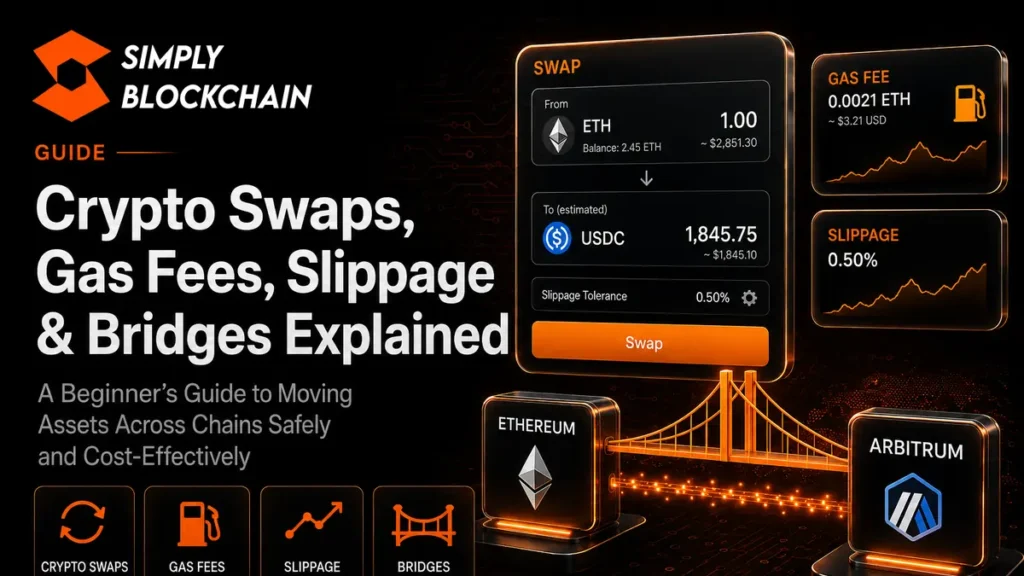
If you are starting to use crypto on-chain, four concepts appear almost immediately: crypto swaps, gas fees, slippage and bridges. A swap lets you exchange one token for another through a blockchain application. Gas fees are the network costs paid to process transactions. Slippage is the difference between the price you expect and the execution you actually receive. A bridge provides a route for assets or data to move between separate blockchain networks.
These concepts are connected. A swap normally requires a network fee, the final amount received can be affected by price movement and liquidity, and a bridge may be needed before an asset can be used on another network. Understanding all four before clicking Confirm can prevent expensive beginner mistakes.
If you are still getting comfortable with self-custody, start with our beginner guide to crypto wallets and wallet setup and funding guide.
On this page
Why these concepts matter together
On a centralised exchange, much of the technical complexity is hidden behind buy and sell buttons. On-chain, you interact with wallets, smart contracts and different networks directly. That gives you more control, but it also makes transaction details more important.
A typical journey might involve funding a wallet, connecting to a decentralised exchange, swapping one token for another, paying the network fee, accepting a defined amount of slippage and later bridging the asset to another network. Each step introduces different costs and risks.
What is a crypto swap?
A crypto swap is an exchange of one digital asset for another. On-chain swaps are commonly handled by decentralised exchanges, or DEXs, where a smart contract executes the trade rather than a central company taking custody of your funds.
Many DEXs use liquidity pools. These pools hold assets that traders can exchange against. The available liquidity, trade size, protocol fees and route all influence the final result.
What happens when you press Swap?
- Select the correct network.
- Select the token you want to swap from.
- Select the token you want to receive.
- Enter an amount.
- Review the estimated output, fees, price impact and slippage.
- Approve token access if required.
- Confirm the transaction in your wallet.
The transaction is then submitted to the network. Once confirmed, your wallet should reflect the new balances.
Liquidity and price impact
Liquidity describes how much of the relevant assets are available for trading. Deep liquidity generally makes it easier to execute a trade without dramatically changing the price.
Price impact is the price movement caused by your own trade relative to the liquidity available. This is different from slippage. A large order placed into a small pool can materially change the pool price and leave you with a worse result.
Before confirming an unfamiliar swap, check the estimated output, price impact, liquidity, token contract, network and total fees. Very low liquidity deserves extra caution.
What are gas fees?
Gas fees are transaction fees paid for computation and block space. On Ethereum, gas measures the computational effort required to execute an operation. A simple ETH transfer requires less work than many smart-contract interactions.
Ethereum explains that the fee is based on gas used and the cost per unit of gas. The modern fee system includes a protocol-set base fee and a priority fee. Most wallets estimate these values automatically, so beginners usually do not need to calculate them manually.
Why gas fees change
- Network demand: more users competing for block space can increase fees.
- Transaction complexity: complex smart-contract calls can use more gas.
- Network choice: different chains and Layer 2 networks have different fee structures.
- Urgency: priority mechanisms can affect how quickly a transaction is included.
Keep some native token for fees
A common beginner mistake is spending or transferring the entire native-token balance. Ethereum transactions require ETH for gas; other networks use their own fee assets. If you hold tokens but no native asset for fees, you may be unable to move them until the wallet is funded again.
Can a failed transaction still cost money?
Yes. On Ethereum, a transaction that reaches execution can consume gas even if the intended smart-contract action fails, because the network still performed computational work. Repeatedly retrying a transaction without understanding the error can therefore cost money.
What is slippage in crypto?
Slippage is the difference between the output expected when a swap is submitted and the output available when it executes. Markets can move while a transaction is pending and liquidity conditions can change.
DEX interfaces therefore use a slippage tolerance: the maximum execution difference you are prepared to accept before the transaction should fail rather than complete outside that limit.
Why not simply use very high slippage?
Higher tolerance can make a volatile or difficult trade more likely to execute, but it can also allow a substantially worse result. Uniswap warns that setting slippage too low can cause a transaction to revert, while setting it too high can result in receiving fewer tokens than expected.
If a swap suddenly requires unusually high slippage, do not blindly increase the setting. Check liquidity, volatility, token mechanics, route and contract address first.
Slippage versus price impact
Price impact is the effect your own trade has on the quoted market because of available liquidity. Slippage is the difference between the expected and actual execution as conditions change. Interfaces may show both, and both deserve attention.
What is a crypto bridge?
A crypto bridge connects separate blockchain ecosystems. Blockchains normally operate as isolated systems and cannot freely move tokens or information between one another. Bridges provide a mechanism for cross-chain communication and asset movement.
For example, someone holding ETH on Ethereum Mainnet may want to use an application on Arbitrum. A supported bridge can move the value to the destination network.
How bridges work
There is no single bridge design. Ethereum documentation describes approaches including lock-and-mint, burn-and-mint and atomic-swap-style mechanisms. Some bridges are native to a particular ecosystem, while others use external validators, messaging systems or liquidity networks.
This means bridges have different security assumptions. Do not assume every bridge is interchangeable simply because the user interface looks similar.
Bridging is not the same as sending
A normal transfer moves an asset to another address on the same network. Bridging changes the network on which the asset or representation of that value becomes available. Sending tokens directly over an unsupported route does not automatically bridge them.
Bridge risks beginners should understand
Bridges are useful but introduce additional technology and trust assumptions. Ethereum’s documentation highlights trade-offs around security, convenience, connectivity and cost, and notes risks including smart-contract bugs, technology failures, user error and—in some bridge models—operator or custodial risk.
Before using a bridge, verify the official source, supported networks, supported asset, destination address, expected fees and expected completion time. If you are using a route for the first time, consider testing with a small amount.
How to bridge crypto more safely
- Start from an official source. Avoid clicking unknown bridge adverts or links from unsolicited messages.
- Verify source and destination networks. Read both network names before signing.
- Check the exact asset. A ticker alone is not enough.
- Review the destination address.
- Keep enough native token for fees. You may need gas on the destination network after arrival.
- Test unfamiliar routes with a small amount.
- Wait for completion. Do not repeat a transfer simply because it takes longer than a normal send.
Swaps versus bridges
A useful beginner shortcut is: a swap changes the asset; a bridge changes the network.
If you swap ETH for USDC on Ethereum, you changed the token while remaining on Ethereum. If you bridge ETH from Ethereum to Arbitrum, you changed the network where that value is available.
Some interfaces now combine swapping and bridging into one cross-chain route. The same checks still apply: know what asset you are sending, what you expect to receive, which network it will arrive on and the total cost.
Practical example: exchange to DEX on another network
Imagine you buy ETH on a centralised exchange and want to use an application on Arbitrum. You might withdraw to your self-custody wallet, verify arrival, use an official supported bridge, keep enough ETH for fees on the destination network, connect to the DEX, select the swap and then review the route, price impact, gas and slippage before confirming.
This shows how the concepts work together: the bridge gets value to the correct network, gas pays for the transactions, the DEX performs the swap and slippage defines how much execution movement you are prepared to accept.
Common beginner mistakes
Using the wrong network
A token name or ticker is not enough. Verify the network and contract address where appropriate.
Using the entire native-token balance
Leaving no gas can prevent future transactions.
Ignoring price impact
Low-liquidity pools can produce surprisingly poor execution.
Increasing slippage until a swap works
This can expose you to a much worse fill and may hide a deeper problem.
Using a bridge from an advert or unsolicited link
Start from the official network or project documentation instead.
Signing without reading the wallet prompt
A signature or transaction is an instruction to your wallet. Read what you are authorising.
On-chain transaction checklist
- I am on the correct network.
- I have verified the token where necessary.
- I have enough native asset for fees.
- I understand the estimated network fee.
- I checked price impact.
- I reviewed slippage tolerance.
- I know whether I am swapping, bridging or doing both.
- I verified the destination network.
- I am using the official application or a trusted bookmark.
- I am comfortable with the amount at risk.
Official resources
These current official resources provide deeper technical and practical explanations:
- Ethereum.org — Gas and fees technical overview
- Uniswap — Slippage settings and execution
- Ethereum.org — Blockchain bridges
- Ethereum.org — How to bridge tokens to Layer 2
Frequently asked questions
Do all crypto transactions have gas fees?
Blockchains use different fee models, but on-chain transactions generally require some form of network fee. The asset used to pay it depends on the network.
What slippage should a beginner use?
There is no universal percentage that is correct for every token and market. Use the application’s sensible default where appropriate and investigate rather than automatically increasing tolerance when a trade struggles to execute.
Can I bridge any token to any blockchain?
No. Bridges support specific networks and assets. Always verify the route before sending.
Why do I have tokens but cannot make a transaction?
You may not have enough of the network’s native fee asset. Check the wallet’s network and required gas token.
Is a bridge the same as a DEX?
No. A DEX primarily swaps assets. A bridge primarily moves assets or information between networks, although some interfaces combine both functions.
Final thoughts
Crypto swaps, gas fees, slippage and bridges can look complicated because they often appear together. Once you separate their jobs, the process becomes easier to reason about: swaps change assets, gas pays for network execution, slippage controls acceptable execution movement and bridges connect separate networks.
Before confirming an on-chain transaction, slow down and check the network, token, address, fees and expected output. For more protection before interacting with unfamiliar protocols, read our crypto security guide and guide to avoiding crypto scams and phishing.
This guide is for educational purposes only and is not financial advice. Cryptoassets and on-chain applications involve risk. Always verify addresses, networks, contracts and official sources before signing a transaction.
