
Quick answer: what are gas fees?
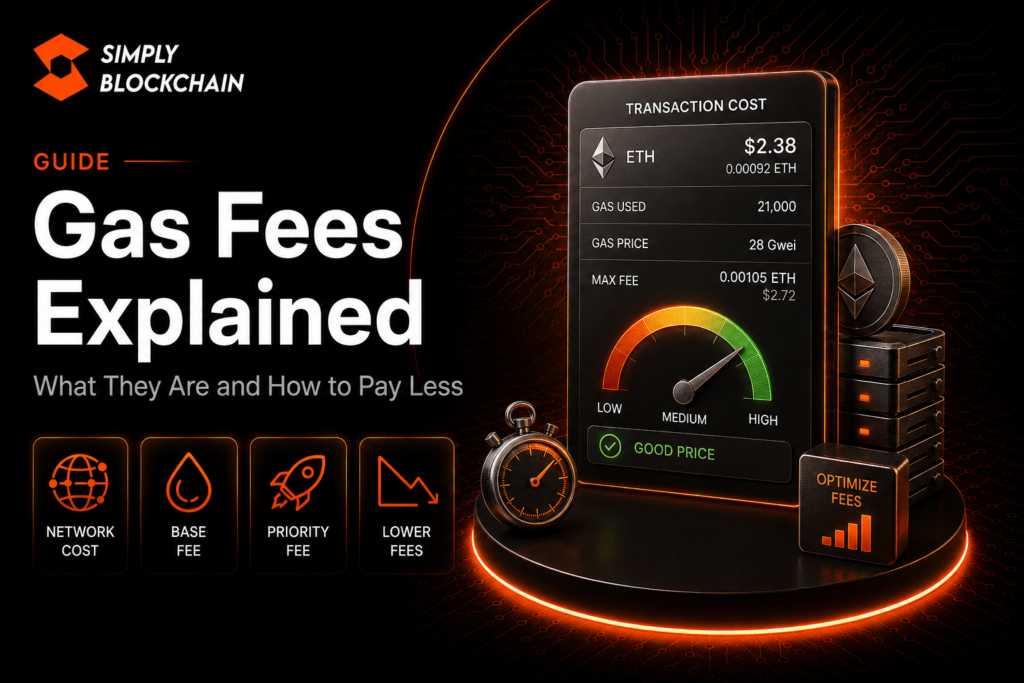
Gas fees are transaction costs paid to a blockchain network when you send assets or execute on-chain actions such as swaps, token approvals, NFT transfers or smart-contract interactions. On Ethereum, the term gas has a specific technical meaning: it measures the computational work required to execute a transaction, and the fee is paid in ETH.
Other blockchains may use different fee models or terminology, but the beginner principle is similar: you normally need the network’s required fee token in your wallet before a transaction can be processed.
Gas is one of the four core concepts covered in our Crypto Swaps, Gas Fees, Slippage & Bridges pillar guide. This article goes deeper into fees and how to manage them.
On this page
Why do blockchain transactions have fees?
A blockchain is not a free database. Nodes and validators have to process transactions, execute smart-contract logic and maintain consensus about the network state. Fees create an economic cost for using those resources and help deter spam.
Ethereum’s official gas fee guide explains that every transaction requires payment, that fees vary with demand, and that gas exists in part to prevent malicious actors from overwhelming the network with computation.
This means the fee is not simply a charge added by your wallet. Your wallet estimates and displays what the network transaction is expected to cost.
What does “gas” actually measure?
On Ethereum, gas measures computational effort. A simple ETH transfer requires less work than a complex interaction with several smart contracts, so it generally uses fewer gas units.
Ethereum’s developer documentation describes the total fee using the relationship between gas used and the price paid per unit of gas. Modern wallets normally hide most of the calculation, but the underlying idea is useful: more computation and greater demand can mean a higher total fee.
The official Ethereum gas documentation also explains base fees, priority fees and gas limits in more technical detail.
Base fee, priority fee and gas limit
Base fee
On Ethereum, each block has a protocol-defined base fee. That portion must be paid for a transaction to be valid and is burned rather than paid to the validator.
Priority fee
A priority fee, often described as a tip, can incentivise a validator to include the transaction sooner when blocks are busy.
Gas limit
The gas limit is the maximum amount of gas units a transaction is allowed to consume. A simple transfer and a complex contract interaction have very different gas requirements. Most wallets estimate an appropriate limit automatically.
Beginners usually do not need to manually tune these fields. Understanding what they represent is more important than changing them without a reason.
Why do gas fees change?
Network demand changes throughout the day. When many users want limited block space at the same time, the price of inclusion can rise. Fees can also differ because one action is more computationally complex than another.
A wallet transfer, token approval and DEX swap are not equivalent operations. A swap may call smart-contract functions, route through pools and update several pieces of on-chain state, so its fee can be higher than a basic transfer.
What token do you use to pay gas?
The required fee token depends on the network. On Ethereum Mainnet, gas is paid in ETH. Many other networks also require their native network token or a specified fee asset.
This creates a common beginner problem: you may hold plenty of USDC or another token but still be unable to move it because you have no native asset available to pay the network fee.
Our blockchain networks and gas tokens guide explains how to identify the chain you are using and which asset you need for fees.
Why can a failed transaction still cost gas?
On Ethereum, a transaction can consume computation before ultimately reverting. The intended state change may be undone, but the network still performed work while executing the transaction. Ethereum’s technical documentation notes that fees can be consumed even when execution fails.
That is why repeatedly submitting the same failing transaction can be expensive. If something fails, diagnose the cause before immediately trying again.
How to pay less in gas fees
Use the right network for the job
Some transactions do not need to happen on Ethereum Mainnet. Ethereum’s own guidance highlights layer-2 networks as a way to access lower transaction costs while still interacting with the Ethereum ecosystem.
Wait for quieter network conditions
If a transaction is not urgent, network demand may be lower later. Wallets and block explorers often show current fee estimates.
Avoid unnecessary approvals and repeated actions
Every extra on-chain transaction can add cost. Understand whether a token needs approval before swapping and avoid repeatedly approving or revoking without a security or usability reason.
Combine your planning
Before bridging or swapping, make sure you know the complete sequence. Bridging to a new network and then discovering you have no native gas token on the destination chain can leave assets temporarily difficult to use.
Do not blindly choose the fastest fee
If your wallet offers slow, market and fast options, the fastest setting may pay a larger priority fee. For non-urgent transactions, a normal recommended fee may be sufficient.
Gas fees when swapping crypto
DEX swaps require network fees because the blockchain must execute the swap contract. Some tokens also need a separate approval transaction, meaning you may pay for an approval and then pay again for the swap.
Before confirming a crypto swap, compare the network cost with the size of the trade. Paying a £10 equivalent fee to move £20 worth of assets may not make sense even if the transaction itself is technically valid.
Gas fees when bridging crypto
Bridging can involve transactions on the source chain, and sometimes additional steps on the destination chain. The bridge may also charge its own fee or account for liquidity costs.
Always evaluate the total route cost, not just the first number shown. Our how to bridge crypto safely guide explains the practical process.
Network fee versus protocol fee
These are different costs. A network fee pays for the blockchain transaction. A protocol, interface or trading fee may be charged by the application or liquidity mechanism you use.
If a swap says “fee” and “network cost” separately, do not add them mentally into one category. Review each component so you understand where the cost comes from.
Gas fees checklist
- I am on the correct network.
- I know which token is required for transaction fees.
- I have enough fee token left after the transaction.
- I understand whether this action requires one transaction or several.
- I have compared the network fee with the value of the transaction.
- I am not repeatedly resubmitting a failing transaction without diagnosing it.
- I have checked whether a lower-cost network or layer 2 is appropriate.
- I know the difference between network fees and protocol/trading fees.
Frequently asked questions
Why do I need ETH if I am sending USDC?
If the USDC is on Ethereum Mainnet, the transaction itself must still be processed by Ethereum, so the network fee is paid in ETH.
Can I pay Ethereum gas fees in USDC?
Standard Ethereum transactions use ETH for gas. Some wallets or account-abstraction systems can provide alternative user experiences, but you should not assume a token balance can automatically pay the underlying network fee.
Why is a swap more expensive than a transfer?
A swap usually executes more smart-contract logic than a simple transfer, so it can consume more gas units.
Are low gas fees always better?
Lower cost is useful, but an unrealistically low fee setting can delay a transaction or make it less likely to be included promptly. Use wallet estimates and consider how urgent the action is.
Final thoughts
Gas fees make much more sense when you stop viewing them as a mysterious wallet charge and start viewing them as the cost of getting work executed by a blockchain network.
Before transacting, know the network, know the fee token, keep a small balance available for the next action and evaluate the total cost of the full route rather than a single screen in isolation.
This guide is educational and does not guarantee any particular transaction cost. Network conditions and fee mechanisms can change.
