Quick answer: how do you buy your first cryptocurrency?
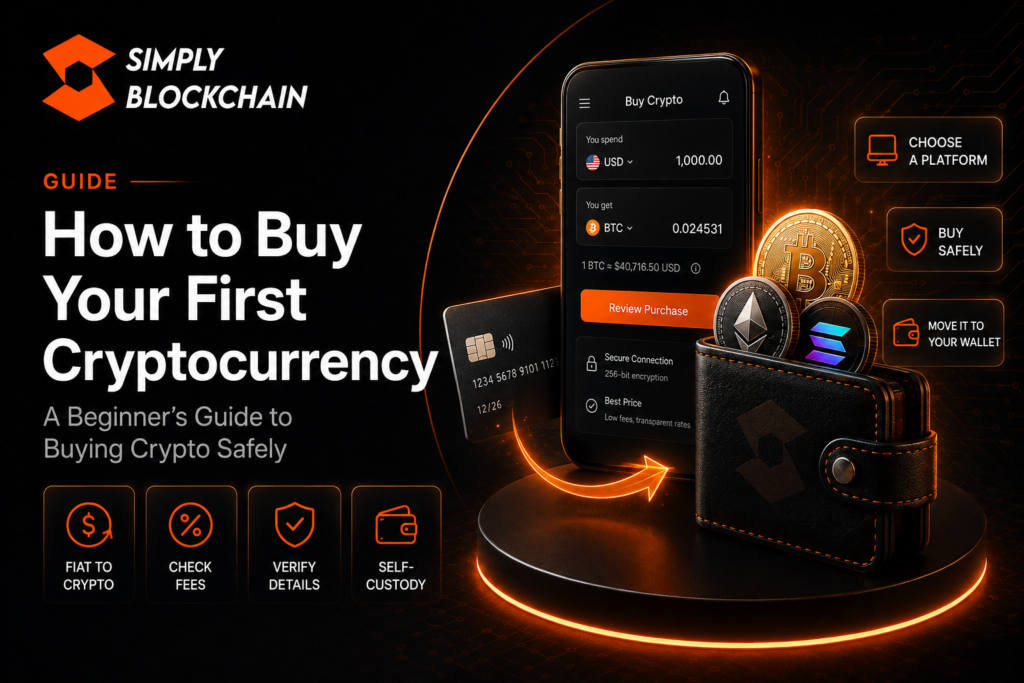
To buy your first cryptocurrency, use a reputable exchange or regulated on-ramp available in your country, create and secure your account, deposit a small amount of money, choose the asset you actually intend to buy, review the fees and order details, and then decide whether to leave the crypto with the provider temporarily or withdraw it to your own wallet.
For a beginner, the safest approach is usually to start small, avoid leverage, ignore social-media pressure and learn the full process before committing more money.
If you plan to withdraw your crypto into self-custody, read our crypto wallet guide first so you understand addresses, networks and recovery phrases.
Table of Contents
Before you buy any crypto
Buying cryptocurrency is easy compared with understanding what you are buying and how you will keep it secure. Before opening an account, decide why you are buying, what asset you intend to purchase and whether you understand the risks.
Crypto prices can move quickly. A beginner should not treat a purchase as guaranteed profit or assume that a popular token will increase in value. Only use money you can afford to expose to loss.
It is also worth deciding where the crypto will live after the purchase. You can keep it in an exchange account for convenience, or withdraw it to a self-custody wallet if you are ready to manage the keys yourself.
Step 1: choose a reputable platform
A cryptocurrency exchange or on-ramp lets you convert traditional currency into crypto. The right platform depends on your country, payment methods, supported assets, fees and withdrawal options.
Before depositing money, check:
- whether the service operates in your country;
- which cryptocurrencies and networks it supports;
- deposit, trading and withdrawal fees;
- whether you can withdraw crypto to your own wallet;
- its security features and account-recovery process;
- whether the web address and application are the genuine official versions.
Avoid choosing a platform simply because an influencer promises a bonus or because an advert appears at the top of a search page. Verify the provider independently.
Step 2: create and secure your account
Most centralised exchanges require an email address, password and identity checks before you can buy or withdraw crypto. The exact requirements depend on the provider and local rules.
Use a unique password that you do not reuse elsewhere. If the platform supports stronger authentication such as a passkey or authenticator app, use it where practical. Avoid relying solely on SMS if stronger options are available, because phone numbers can be targeted through SIM-swap attacks.
Your email account also matters. If somebody controls the email linked to an exchange, they may be able to reset passwords or approve security changes. Protect that account with its own strong authentication.
Step 3: complete identity verification if required
Many exchanges use identity verification, often called KYC or “Know Your Customer”. You may be asked for identification, address information or a selfie.
Complete verification only through the official exchange website or application. Be suspicious of anyone who contacts you privately and asks you to send identity documents through chat, Telegram or social media.
Verification can take time, so do not feel pressured to rush through it because the market is moving.
Step 4: deposit a small amount of money
Once the account is ready, choose a supported funding method. Common options can include bank transfer, debit card or another payment service, depending on the platform and your location.
Compare the total cost rather than looking only at convenience. A payment method with instant processing may carry higher fees than a bank transfer.
For your first purchase, consider depositing a small amount. The goal is to learn the process safely, not to maximise exposure immediately.
Step 5: choose the cryptocurrency carefully
Make sure you are buying the exact asset you intend to buy. Cryptocurrency tickers can look similar, and scam tokens can copy names or branding.
For widely traded assets, the exchange usually presents a clear market such as BTC/GBP, BTC/USD or ETH/GBP. Smaller tokens may require more careful checking.
If you do not understand the asset, its network or why you want to own it, stop before buying. A purchase should not be based solely on a social-media post, price prediction or fear of missing out.
Step 6: understand the order screen
Most beginner-friendly exchange interfaces offer a simple “Buy” function. More advanced trading screens may offer market and limit orders.
Market order
A market order attempts to buy at the best available market prices. It prioritises execution rather than a precise price. In liquid markets, the final price may be close to what you see on screen, but there can still be a difference.
Limit order
A limit order lets you specify the maximum price you are willing to pay. The order will only execute if the market reaches a suitable price, so it may never fill.
For a small first purchase, simplicity matters more than using advanced order types. Whichever method you choose, review the amount, estimated price and fees before confirming.
Step 7: check the fees and spread
The headline trading fee is not always the only cost. Depending on the platform, you may encounter:
- deposit or card-processing fees;
- trading fees;
- a spread between the quoted buy and sell price;
- withdrawal fees;
- blockchain network fees when sending crypto off the platform.
A platform that appears “free” can still build costs into the quoted price. Check what you are paying in total.
Step 8: make the first purchase
Before pressing confirm, check the asset, amount, quoted price and fees one more time. Then complete the purchase.
After the order executes, the exchange should show the crypto balance in your account. That does not necessarily mean you control the private keys. On a typical centralised exchange, the company is holding the underlying crypto on your behalf.
If you are comfortable with that arrangement while you learn, you do not need to withdraw immediately.
Should you withdraw your crypto to a wallet?
Self-custody gives you direct control of the private keys, but it also removes the exchange’s password-recovery safety net for the wallet itself.
If you are ready to withdraw, first create and secure a compatible wallet. Our wallet setup and funding guide walks through that process.
When withdrawing, make sure the asset and blockchain network match the receiving wallet. Send a small test amount first. Once it arrives correctly, you can consider transferring the remainder.
Exchange account vs self-custody wallet
| Question | Exchange account | Self-custody wallet |
|---|---|---|
| Who controls the private keys? | Usually the exchange | You |
| Password recovery | Usually available | Recovery depends on your backup |
| Easy for a beginner? | Usually easier | Requires more learning |
| Direct access to on-chain apps? | Usually limited | Usually yes, if supported |
| Main responsibility | Protect the exchange account | Protect keys, recovery phrase and signing decisions |
Neither option is risk-free. The right choice depends on your confidence, intended use and willingness to manage self-custody securely.
Common mistakes when buying crypto for the first time
Buying because the price is moving quickly
Urgency is a poor reason to make a financial decision. If you feel pressured because a token is suddenly rising, step away and review the decision when you are calmer.
Using leverage immediately
Leverage magnifies both gains and losses. It can cause a position to be liquidated quickly and is not necessary for learning how to buy cryptocurrency.
Buying a token you have not verified
Names and tickers can be copied. Verify the exact asset before buying, especially with smaller cryptocurrencies.
Ignoring withdrawal support
If you eventually want self-custody, confirm that the platform lets you withdraw the asset on a network your wallet supports.
Sending the entire balance as the first withdrawal
Use a test transaction before moving a larger amount to a new address.
Following unsolicited “support” messages
Scammers often impersonate exchanges and wallet teams. Do not share passwords, one-time codes, private keys or recovery phrases.
How much should a beginner buy?
There is no correct amount. A first purchase can be small enough that you are comfortable treating it as a learning exercise.
Your first goal should be understanding the process: deposit money, place an order, see how fees work, withdraw a test amount if appropriate and confirm the transaction.
Once you can do those things confidently, you can make future decisions with more information.
Do you have to buy a whole Bitcoin or Ethereum?
No. Major cryptocurrencies can be divided into smaller units, so you can usually buy a fraction of a coin. A beginner does not need enough money to buy one entire Bitcoin or Ether.
Is buying crypto the same as trading crypto?
No. Buying crypto simply means acquiring an asset. Trading usually refers to making repeated buy and sell decisions, often with shorter time horizons and potentially more complex tools.
You do not need to become a trader to use or learn about cryptocurrency. The Simply Blockchain roadmap starts with understanding wallets, security and on-chain basics before moving into trading tools.
Beginner security checklist before you buy
- You are on the official exchange or on-ramp website.
- Your account password is unique.
- Strong two-factor authentication or a passkey is enabled where available.
- Your email account is secured separately.
- You understand the asset you are buying.
- You have reviewed the fees.
- You are not using money you need for essential expenses.
- You know where the crypto will be stored after purchase.
- You understand that no legitimate support agent needs your seed phrase or private key.
Frequently asked questions
Can I buy cryptocurrency with a small amount of money?
Usually, yes. Many platforms allow fractional purchases, subject to their minimum transaction limits.
Do I need a crypto wallet before buying crypto?
Not necessarily. A centralised exchange can hold the crypto in your account. You need a self-custody wallet if you want to withdraw and control the private keys yourself.
What is the easiest crypto to buy first?
The easiest asset operationally is usually one that is widely supported by reputable platforms and whose network you understand. This is not the same as saying it is a good investment.
Can I lose money after buying crypto?
Yes. Cryptocurrency prices can fall significantly, and security mistakes can also cause losses. There are no guaranteed returns.
Should I buy crypto from someone on social media?
Avoid sending money to strangers or informal sellers. Use a reputable platform and verify the service independently.
Official cryptocurrency resources
For additional guidance before buying cryptocurrency, these official UK resources provide useful information on cryptoassets, the risks involved and the protections available to consumers.
• FCA — Crypto: The basics
• FCA — Investing in crypto
What to learn next
If you plan to move your crypto into self-custody, continue with How to Set Up & Fund Your Crypto Wallet.
Before connecting a wallet to trading tools or decentralised applications, read our crypto security guide and guide to avoiding crypto scams and phishing.
For the full beginner sequence, follow the Simply Blockchain Start Here roadmap.
Educational disclaimer
This article is for educational purposes only and is not financial or investment advice. It does not recommend any cryptocurrency, exchange or purchase. Crypto assets are volatile and can result in substantial losses. Always research services and assets independently before using them.
