
Quick answer: what are liquidity and price impact?
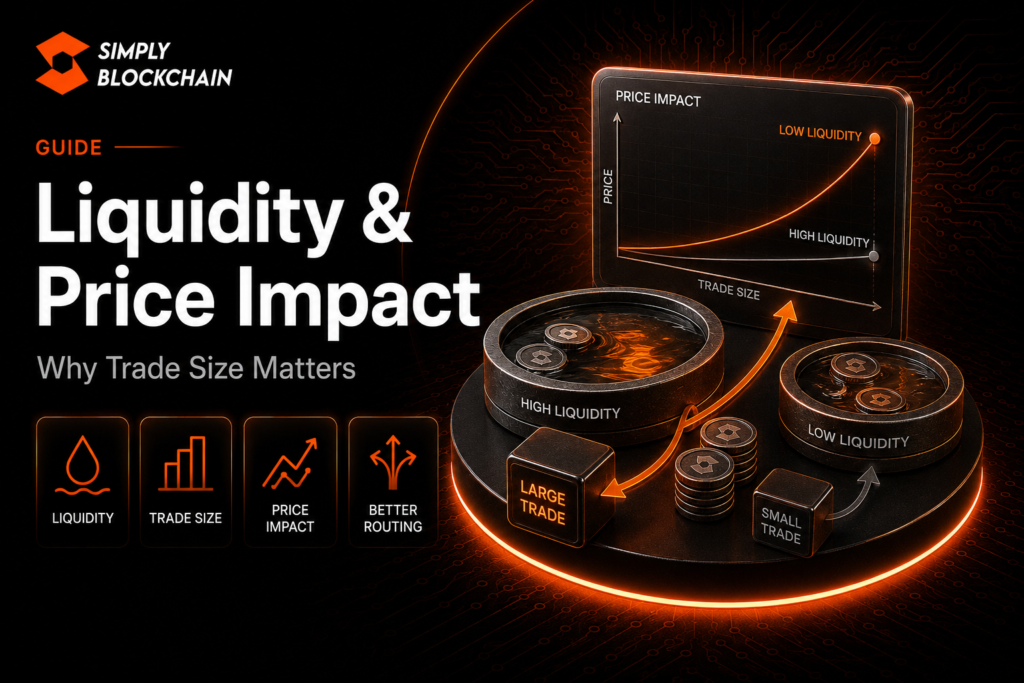
Liquidity and price impact are two of the most important ideas to understand before swapping crypto on a decentralised exchange. Liquidity is the amount of usable market depth available for trading. Price impact is the change in price caused directly by your own trade relative to that available liquidity.
If a pool is deep and your trade is small, price impact may be minimal. If a pool is shallow or your order is large, the same trade can move the price substantially and give you a worse effective rate.
This is one of the mechanics behind the swap experience described in our Crypto Swaps, Gas Fees, Slippage & Bridges pillar.
On this page
What is liquidity in crypto?
Liquidity describes how easily an asset can be bought or sold without causing a large price change. On a centralised exchange, liquidity may be visible in an order book. On many DEXs, liquidity is supplied to smart-contract pools.
Uniswap’s liquidity pool guide describes a pool as a pair of tokens held in a smart contract and used for swaps. Liquidity providers contribute assets to the pool, creating the inventory traders interact with.
How do liquidity pools set prices?
Automated market makers use mathematical rules to determine prices based on the assets available in a pool. A trade changes the pool balances, which changes the rate for the next portion of the trade and for subsequent traders.
The exact formula varies by protocol and pool type, so beginners do not need to memorise equations. The practical lesson is enough: your order consumes liquidity, and consuming a large share of available liquidity moves the price.
What is price impact?
Price impact is the difference between the current market or pool price and the effective price produced by your own transaction.
Uniswap’s official price impact explanation states that price impact is the price change directly caused by a trade and that deeper liquidity generally produces smaller impact for the same order size.
That makes price impact a useful warning before you sign. If the interface says your trade will materially move the pool, the problem exists before the transaction is submitted.
Why does trade size matter?
Imagine a pool with £10 million of active liquidity and another with £10,000. A £1,000 trade is tiny relative to the first pool but large relative to the second. Even if both display a similar headline price, the actual execution can be very different.
Price impact is therefore relative, not absolute. A trade that is harmless in one market can be uneconomic in another.
Price impact versus slippage
Price impact is caused by your own trade. Slippage is the difference between the expected result and the result at execution because the market or route changes before confirmation.
Uniswap’s price impact vs price slippage page separates the concepts in exactly this way.
Our crypto slippage guide explains maximum slippage and minimum received in more detail.
How can you reduce price impact?
Use deeper liquidity
A market with more usable liquidity can normally absorb a larger order with less movement.
Reduce trade size
A smaller transaction consumes less of the pool. Splitting trades can sometimes reduce instantaneous impact, although market movement and repeated gas fees may offset the benefit.
Use better routing
DEX routers can search several pools and sometimes split a trade across routes. That can improve execution compared with using one shallow pool.
Avoid illiquid tokens
If a token has very little liquidity, there may simply be no economical route for the trade size you want.
Does high liquidity mean a token is safe?
No. Liquidity is a market property, not a security audit. A token can have substantial liquidity and still contain malicious code, centralised controls or other risks.
Likewise, visible liquidity can sometimes be removed or manipulated. Verify the token contract and project independently using our crypto verification guide.
How to read price impact on a swap screen
Many swap interfaces display price impact as a percentage. Treat it as an execution-cost signal. The higher the percentage, the further your average execution price moves away from the pre-trade market price because of your order.
Always translate the percentage into an amount you understand. A 1% impact on a £100 trade is very different from 1% on a £50,000 trade.
Liquidity, price impact and meme coins
New or speculative tokens often have smaller pools and faster-moving liquidity. That can produce large price impact even when the token appears to have significant headline trading volume.
Check the actual pool, route and contract rather than relying on social-media claims about “liquidity”. If the swap warns about a large impact, investigate before proceeding.
Liquidity depth versus headline liquidity
A single “liquidity” number can hide important details. What matters to your trade is the liquidity that is actually usable around the current price and along the route selected by the DEX. Concentrated-liquidity designs can place capital inside specific price ranges, so two pools with similar total value can still behave differently for a particular order.
This is why the swap preview is more useful than a social-media claim that a token has “millions in liquidity”. Look at the actual quoted output, price impact and route for the amount you intend to trade.
What is market depth?
Market depth describes how much buying or selling can occur before the price changes materially. On an order-book exchange, depth can be seen in the stack of bids and asks. In an AMM, the available pool liquidity and pricing curve create the equivalent trading depth.
Deep markets tend to produce tighter execution for larger orders. Shallow markets can look normal at the headline price but deteriorate quickly once a trade begins consuming available liquidity.
Why can two DEXs quote different prices?
Different DEXs may use different pools, fee tiers, liquidity providers and routing logic. One interface may find a deeper route than another. Aggregators can search multiple venues and split an order, but they also add routing complexity and may introduce additional smart contracts.
Compare the final amount received after fees rather than assuming the interface with the best headline token price provides the best execution.
Liquidity and exit risk
Buy-side liquidity is only half the story. Before entering a small token, ask whether there is enough depth to exit later. A position that is easy to buy in a rising market can become difficult to sell if liquidity is removed or concentrated elsewhere.
This is particularly relevant for speculative tokens where liquidity providers may be few in number. A token balance in your wallet does not guarantee there will be a liquid market when you want to sell.
Can liquidity be removed?
Yes. Depending on the pool design, liquidity providers can often withdraw their positions. Some projects use locked liquidity or protocol-owned liquidity, but those terms need to be verified rather than accepted from marketing.
If a token’s safety depends heavily on one pool, understand who controls the liquidity position and whether there are mechanisms that prevent sudden removal.
Liquidity and price impact checklist
- I have checked the pool or market liquidity.
- I know the price impact of my trade.
- I have compared the trade size with the depth of the market.
- I understand that slippage and price impact are different.
- I have checked the minimum received amount.
- I have verified the token contract.
- I am not assuming high liquidity means the token itself is safe.
- I have compared alternative routes or markets where appropriate.
Frequently asked questions
What is a good price impact?
There is no universal threshold. The important question is whether the execution cost is acceptable for your trade size and whether a better route or deeper market exists.
Can price impact be avoided completely?
Not always. Any trade can affect a market, although the impact may be negligible in a deep pool.
Why does a small token trade show huge price impact?
The pool may be extremely shallow, the route may be poor, or the quoted market price may not reflect executable depth.
Does higher slippage fix price impact?
No. Increasing slippage only allows a wider execution range. It does not create liquidity or remove the price movement caused by your own order.
Final thoughts
Liquidity and price impact explain why a visible token price is not the same as a guaranteed execution price. Markets have depth, and your trade interacts with that depth.
Before a swap, check how much liquidity is available, how much your order moves the market and whether the route still makes sense after fees and slippage.
This guide is educational only and does not recommend any token, pool or trading strategy.
