
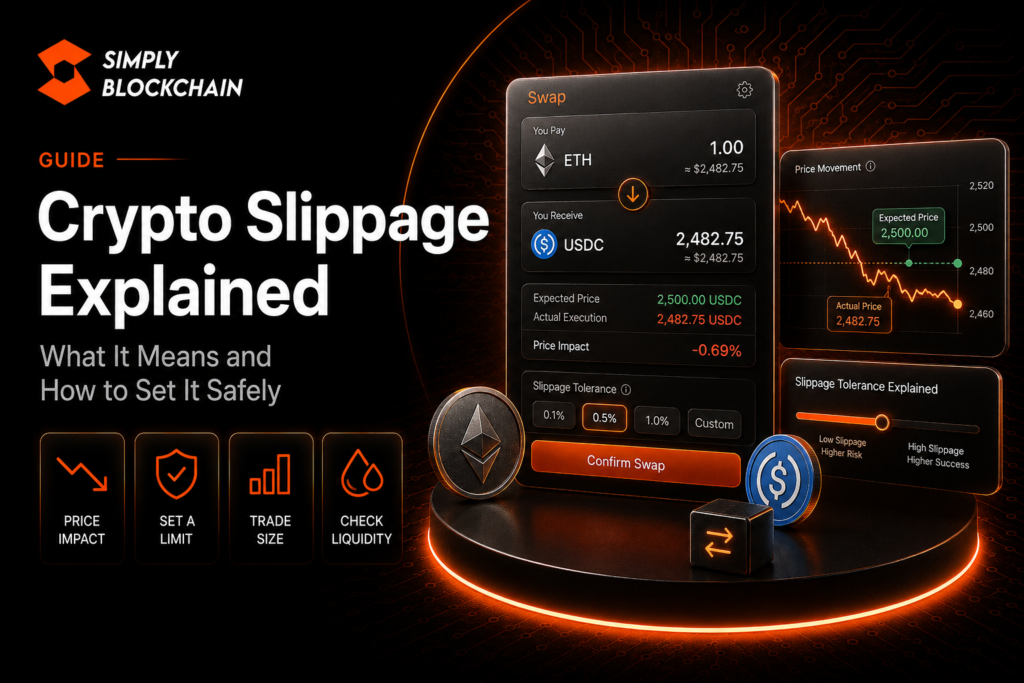
Quick answer: what is crypto slippage?
Crypto slippage is the difference between the price or token amount you expect when submitting a trade and the price or amount you actually receive when the trade executes. It can happen because markets move, available liquidity changes or other transactions affect the pool before yours is confirmed.
Most DEX interfaces protect users with a maximum slippage setting. If the execution would be worse than the permitted amount, the swap may revert instead of completing at that price. Setting the tolerance too low can increase failed trades; setting it unnecessarily high can allow a much worse result than expected.
Slippage is one of the key concepts in our Crypto Swaps, Gas Fees, Slippage & Bridges pillar. This guide focuses on using it safely.
On this page
Why does slippage happen?
A swap quote is a snapshot. There is usually a short period between the app calculating the quote, your wallet signing the transaction and the network actually executing it. During that time the market can change.
Common causes include:
- Volatility: the market price changes quickly.
- Low liquidity: a relatively small trade can move the pool price.
- Large trade size: your own transaction creates meaningful price impact.
- Network delay: the transaction waits while the market continues moving.
- Other trades: transactions ahead of yours change the state of the pool.
- Token mechanics: some tokens charge transfer or buy/sell fees that affect output.
What is slippage tolerance?
Slippage tolerance is the maximum adverse change you are prepared to accept before the swap should fail or revert. If the trade can still execute within that limit, it may proceed. If the result would be worse than the limit, the protection is designed to stop the swap.
Uniswap’s current slippage settings guide explains that setting slippage too low can cause a transaction to fail, while setting it too high may result in receiving fewer tokens than expected.
The correct setting is not a universal number. It depends on the token, liquidity, volatility, trade size, network conditions and the interface being used.
Maximum slippage versus minimum received
Many interfaces convert your slippage setting into a minimum received value. That value is often easier to understand than the percentage.
For example, if the interface expects 1,000 tokens and your protection allows a certain percentage of adverse movement, the minimum received field tells you the lowest amount the transaction can accept before it should revert.
Always look at both the percentage and the actual token amount. A percentage that sounds small can still represent a meaningful amount of money on a large trade.
Price impact is not the same as slippage
Price impact is the price movement caused directly by your trade relative to the pool’s available liquidity. Slippage is the difference between the expected quote and actual execution.
Uniswap’s price impact versus price slippage documentation makes this distinction explicitly.
Our separate liquidity and price impact guide explains why large orders in shallow pools can create poor execution even before market movement is considered.
Why can low slippage make a swap fail?
If the market moves beyond your maximum tolerance before execution, the transaction can revert. Uniswap lists slippage limits as one reason a swap may fail and notes that the real output must remain within the configured limit.
That does not mean the correct response is always to raise slippage. A failure is information. Check the token, liquidity, trade size, network and any token fees before changing the setting.
Why can high slippage be dangerous?
A high tolerance gives the trade permission to execute at a wider range of prices. In a volatile or thin market, that can result in a much worse output than you expected.
It can also reduce one of your protections against adverse ordering and rapid price movement. The exact risks depend on the transaction and execution system, but the general rule is simple: do not set a large tolerance just to make a trade go through.
If a token requires unusually high slippage, investigate why. Possible explanations include low liquidity, transfer taxes, extreme volatility or problematic token mechanics.
How should a beginner choose a slippage setting?
Start with the interface’s recommended or automatic setting when using a reputable protocol, then review the minimum received amount. Automatic settings are designed to account for the market and route available at that moment, although they cannot remove risk.
If you are considering a custom value:
- check liquidity and price impact first;
- consider whether the asset is unusually volatile;
- check whether the token charges transfer or trading fees;
- avoid using a larger tolerance simply because another user suggested a number;
- review the minimum received value before signing.
Slippage and low-liquidity tokens
Small or newly launched tokens may have shallow liquidity. A trade can move the pool price substantially, and the quoted output can change quickly.
Before swapping an unfamiliar token, verify the contract and inspect the market rather than focusing only on the slippage setting. A high tolerance cannot turn a poor or malicious market into a safe trade.
Use our guide to verifying crypto links, contracts and websites before connecting to unfamiliar trading interfaces.
Slippage and token taxes or transfer fees
Some tokens include fees or unusual transfer mechanics in their contracts. These can affect the amount received and may cause a swap to fail if the effective output falls outside the allowed tolerance.
Uniswap’s transaction-failure guidance notes that token fees can require a higher slippage setting in some cases. That is a reason to research the token, not a reason to automatically accept any required tolerance.
Slippage and gas fees are separate
Slippage determines how much adverse execution you are willing to accept. Gas is the network cost of attempting the transaction. A trade can fail because of slippage and still consume network fees if the chain performed work before reverting.
Read our gas fees explained guide if you are unsure why a failed transaction may still cost money.
Crypto slippage checklist
- I have checked the expected output and minimum received.
- I understand the current slippage tolerance.
- I have checked price impact separately.
- I have considered liquidity and trade size.
- I have verified the token contract.
- I am not raising slippage blindly just to force a transaction through.
- I understand any token tax or transfer fee that affects execution.
- I am using a trusted DEX interface or verified application.
Frequently asked questions
Is 1% slippage good?
There is no universal safe percentage. Appropriate tolerance depends on the asset, route, liquidity and market conditions. Review the actual minimum received amount rather than relying on a rule of thumb.
Why does my swap keep failing with low slippage?
The expected output may be moving beyond the allowed limit before execution. Check volatility, liquidity, token fees and network conditions before changing the setting.
Does higher slippage mean a higher gas fee?
Not directly. Slippage controls execution tolerance; gas pays for network computation. They are separate parameters.
Can slippage be positive?
You may sometimes receive a better output than the original quote, depending on the execution mechanism and market movement. Slippage settings are primarily intended to limit adverse execution.
Final thoughts
Crypto slippage is not a mysterious DEX tax. It is the gap between a quote and execution in a market that can change while your transaction is being processed.
Use maximum slippage as a protection rather than a troubleshooting hammer. Check liquidity, price impact, token mechanics and the minimum received amount before signing.
This guide is for educational purposes only. Trading and on-chain execution involve market and smart-contract risk.
