Quick answer: what are blockchain networks?
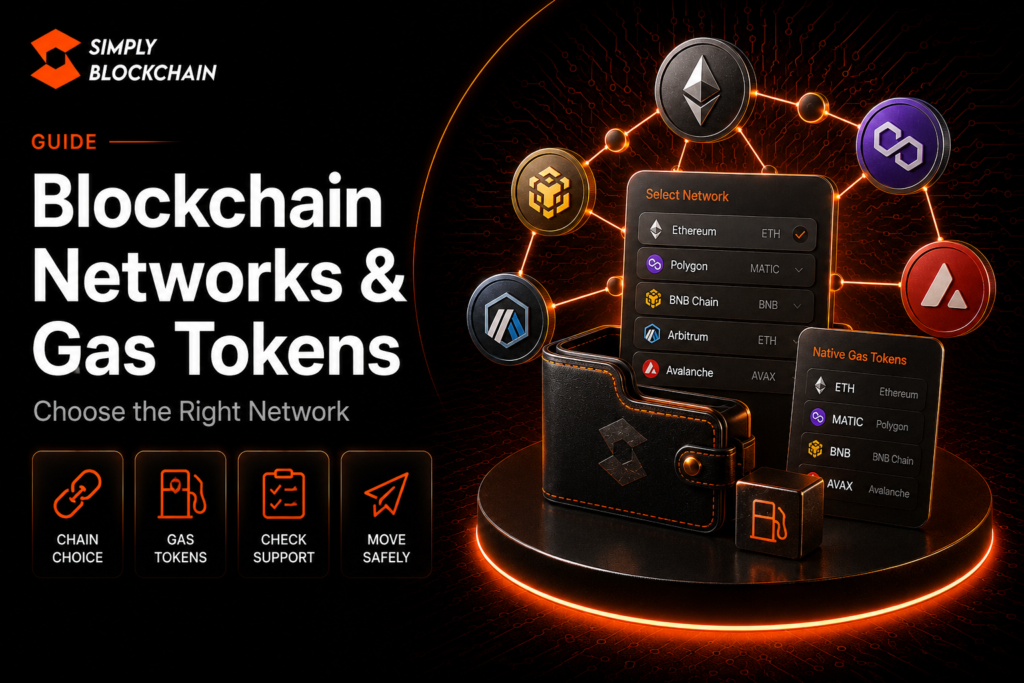
Blockchain networks are separate systems with their own validators or consensus rules, transaction histories, fees and applications. Ethereum, Bitcoin and Solana are different networks. Ethereum layer-2 networks such as Arbitrum and Optimism are also distinct execution environments even though they are designed around Ethereum.
For users, the practical consequence is crucial: the same token name can appear on several networks, and each network may require a different native asset to pay transaction fees.
This is one of the foundations behind our Crypto Swaps, Gas Fees, Slippage & Bridges pillar.
On this page
Why does the network matter?
Your wallet address alone does not tell the whole story. Before sending or withdrawing crypto you need to know which blockchain will process the transaction.
If an exchange says “Choose network” when withdrawing USDC, it is asking which blockchain should receive the token. The destination wallet and application must support that exact network and token contract.
Native coins versus tokens
A native coin is part of the network’s base protocol. ETH is the native asset of Ethereum. SOL is the native asset of Solana. BTC is the native asset of Bitcoin.
A token is issued using the smart-contract or token standard of a network. USDC, for example, can exist on several blockchains as separate token contracts or native issuances.
This distinction matters because network fees are normally paid using the chain’s designated fee asset rather than whichever token you happen to be transferring.
What is a gas token?
“Gas token” is informal user language for the asset you need to pay transaction fees on a network. On Ethereum Mainnet that asset is ETH. Other networks use their own native tokens or fee mechanisms.
Ethereum’s official gas guide explains that Ethereum network fees are paid in ETH and are required for sending transactions and interacting with applications.
Our gas fees explained article covers the fee calculation in more detail.
Why can the same token exist on several networks?
Stablecoins and other assets can be issued or represented on multiple chains. The ticker may be identical, but the token contract and underlying bridge or issuer mechanism can differ.
That is why “USDC” is not enough information for a transfer. You need “USDC on Ethereum” or “USDC on Solana,” and in some ecosystems you also need to know whether it is a native or bridged version.
What happens if you use the wrong network?
There is no universal outcome. If both the sending platform and destination wallet support the same address format across compatible networks, the funds may arrive on a different chain than expected and still be recoverable. In other cases, using an unsupported network can make recovery difficult or impossible.
The safest approach is prevention:
- match the withdrawal network exactly;
- check the destination application’s supported chains;
- verify the token contract;
- send a test amount first when practical.
Ethereum Mainnet versus layer 2
Ethereum Mainnet is the base layer. Layer-2 networks process transactions in separate execution environments and settle or post data back to Ethereum according to their design.
Ethereum’s current gas guidance recommends layer 2 as one way users can access lower transaction costs for suitable applications.
Moving between Mainnet and a layer 2 normally requires a bridge or an exchange withdrawal that supports the destination network.
How wallets handle multiple networks
Some wallets support many chains in one application. Switching the network changes which blockchain state the wallet is reading and which transactions it will submit.
The same wallet interface can therefore show different balances on Ethereum, Arbitrum and another EVM network even when the account address looks identical.
Do not assume an empty balance means the funds are gone. First check whether the wallet is viewing the correct network.
Network selection when withdrawing from an exchange
Exchanges often let you choose from several withdrawal networks for the same asset. The cheapest network is not always the correct one.
Before choosing:
- open the destination wallet or application;
- confirm the supported network;
- confirm the token type;
- copy the receiving address carefully;
- select the matching exchange withdrawal network;
- send a test amount if the value is meaningful.
Network selection when swapping
A DEX swap normally occurs on the network your wallet is connected to. If you want an asset on another network, a normal same-chain swap may not be enough. You may need to bridge or use a cross-chain swap route.
Read Crypto Swaps Explained and Crypto Bridges Explained to understand the difference.
Keep a gas buffer
Do not spend or bridge every unit of the native fee token unless you are certain you will not need another transaction. Keeping a small buffer can prevent a wallet from becoming temporarily stuck.
This matters most when arriving on a new chain with only a non-native token. You may need ETH, SOL or another network token before you can move or swap the asset you just received.
Layer 1, layer 2 and sidechain: what is the difference?
A layer-1 blockchain such as Ethereum or Solana runs its own base consensus. A layer-2 network is designed to scale a base chain by processing activity in another environment and then settling or posting proofs/data back according to its design. A sidechain uses its own consensus and connects to another ecosystem through bridges.
These labels matter because they describe different security assumptions. “EVM compatible” only means a network can run Ethereum-style smart contracts; it does not automatically mean it inherits Ethereum’s security.
What is chain ID?
EVM-compatible networks use chain IDs so wallets and applications can distinguish one network from another. A chain ID helps prevent the same signed transaction from being treated as valid on an unintended network.
Beginners rarely need to memorise chain IDs, but they are useful when manually adding a custom network. Only use RPC URLs and chain information from official network documentation.
What is an RPC?
An RPC endpoint is how a wallet or application communicates with a blockchain node. Changing the RPC does not move your funds or change your private keys; it changes which node service the wallet uses to read data and broadcast transactions.
A malicious or unreliable RPC can misreport information or disrupt the user experience, so do not copy custom RPC settings from random social-media posts.
Why do exchanges show so many network options?
An exchange may support the same asset on several blockchains because users want different fees, speeds and ecosystems. Those options are not interchangeable. The exchange is effectively asking which on-chain version and destination network should receive the withdrawal.
Choose the network based on the destination, not the cheapest withdrawal fee alone.
Bridged versus natively issued stablecoins
Stablecoin issuers can deploy native versions on multiple networks, while bridges can also create wrapped or bridged representations. These may share a ticker but have different contract addresses and redemption assumptions.
Before depositing a stablecoin into a DeFi protocol, confirm the application supports the exact contract you hold.
Blockchain networks checklist
- I know the exact blockchain I am using.
- I know which native asset pays transaction fees.
- I have confirmed the token contract or asset version.
- I have matched the sending and receiving networks.
- I understand whether I need a bridge.
- I will keep a small gas buffer.
- I will use a test transfer when practical.
- I have checked the destination app supports the exact network and token.
Frequently asked questions
Is ERC-20 a network?
No. ERC-20 is a token standard associated with Ethereum-compatible smart contracts. An exchange may use “ERC-20” informally to mean an Ethereum withdrawal, but always verify the actual network name.
Why is my Ethereum address the same on several networks?
Many EVM-compatible networks use the same account derivation and address format. The identical-looking address exists in separate network states, so balances and transactions are still chain-specific.
Can USDC pay gas?
Usually the network requires its designated fee asset rather than USDC. Some wallets or smart-account systems can abstract fees, but you should verify that feature before relying on it.
What is the safest network to use?
There is no universal answer. Use the network supported by the destination service and appropriate for your security, cost and application requirements.
Final thoughts
Most wrong-network mistakes happen because users focus on the token name and ignore the blockchain underneath it.
Before every withdrawal, swap or bridge, identify the chain, token contract and fee asset. That one habit prevents a large class of beginner errors.
This guide is educational only. Networks, wallet support and fee mechanisms change over time.
