
Quick answer: DEX vs CEX
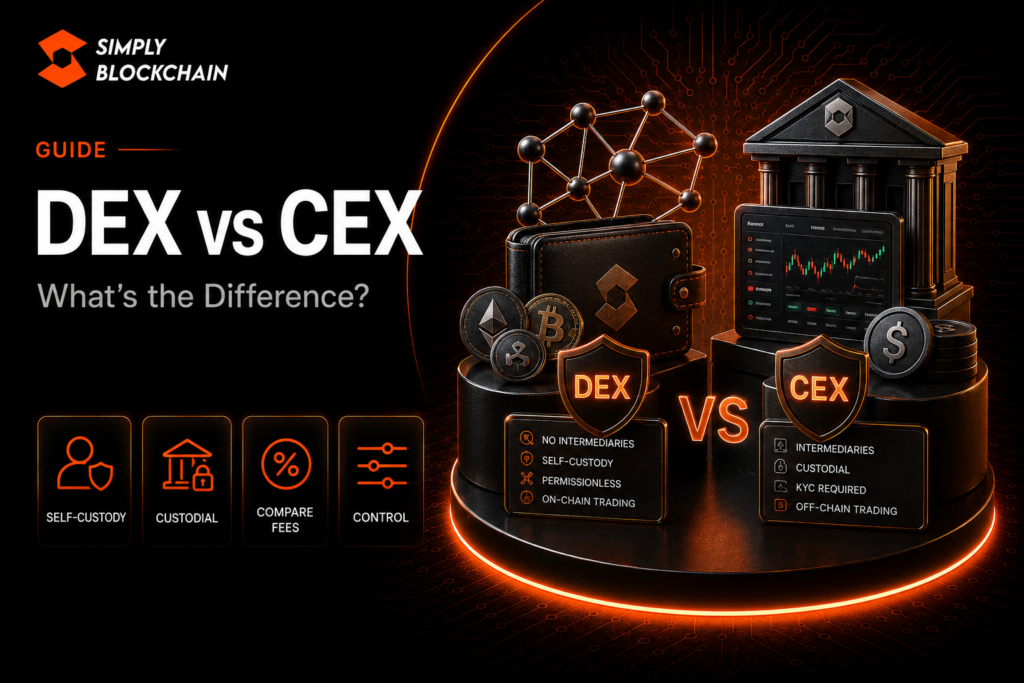
DEX vs CEX is the difference between trading through a decentralised exchange and trading through a centralised exchange. A CEX is operated by a company that typically holds customer balances and manages the trading platform. A DEX uses blockchain smart contracts to let users trade from compatible wallets without depositing assets into the same kind of central exchange account.
A CEX is often easier for buying crypto with pounds, cards or bank transfers. A DEX offers direct on-chain access and self-custody, but you are responsible for wallet security, network fees, token verification and transaction signing.
Understanding both models makes the on-chain swaps and gas pillar much easier to navigate.
On this page
What is a centralised exchange?
A centralised exchange is a platform operated by a company or organisation. Users create an account, complete any required verification, deposit fiat or crypto, and trade using the exchange’s internal systems.
The exchange typically controls the private keys for assets held in the account. Your balance is represented inside the platform until you withdraw it to an external wallet.
CEXs commonly provide fiat on-ramps, order books, customer support and account-recovery processes that can be easier for beginners.
What is a decentralised exchange?
A decentralised exchange lets users interact with blockchain-based trading protocols from their own wallet. Coinbase’s UK DEX guide describes DEXs as smart-contract systems that allow crypto-to-crypto trading without the same centralised intermediary structure.
Many DEXs use liquidity pools and automated market makers, while other decentralised trading systems can use order books or alternative execution mechanisms.
The defining beginner difference is custody: a DEX normally lets you remain in control of your wallet while you authorise individual transactions.
Custody: who controls the assets?
CEX custody
When you leave crypto on a centralised exchange, the platform generally controls the blockchain keys. You rely on the exchange’s security, withdrawal systems and solvency.
DEX self-custody
With a DEX, you connect a self-custody wallet and sign transactions yourself. That removes one central custodian but places more responsibility on you.
If self-custody is new, read What Is a Crypto Wallet? before using a DEX.
Fiat access
CEXs usually have a major advantage for fiat on-ramps and off-ramps. UK users may be able to deposit GBP by bank transfer or card, subject to the exchange’s supported methods and regulations.
A traditional DEX normally swaps one crypto asset for another rather than directly taking money from your bank account. Wallets and DEX interfaces can integrate third-party fiat services, but those are separate services layered onto the on-chain experience.
How prices are formed
Centralised exchanges commonly use order books where buy and sell orders are matched. Many DEXs use liquidity pools and automated market makers.
On a DEX, the pool’s depth directly affects liquidity and price impact. On a CEX, market depth is visible through the order book and available limit orders.
Fees on a DEX versus CEX
A CEX can charge trading fees, spreads, deposit fees or withdrawal fees. A DEX can charge protocol or interface fees while the blockchain also charges a network fee.
Do not compare one fee line in isolation. A DEX swap may look cheap until gas is included; a CEX trade may look cheap until withdrawal fees and spreads are considered.
Our gas fees guide explains the on-chain part of the cost.
Security trade-offs
CEX risks
- exchange hacks or operational failures;
- account takeover;
- withdrawal restrictions;
- counterparty and custody risk.
DEX risks
- malicious token contracts;
- phishing interfaces;
- dangerous approvals or signatures;
- smart-contract vulnerabilities;
- user mistakes with networks and addresses.
Moving from a CEX to a DEX does not remove risk; it changes who is responsible for managing it.
Privacy and account requirements
Centralised exchanges commonly require an account and identity verification depending on jurisdiction and services offered. A permissionless DEX can often be accessed by connecting a compatible wallet.
That does not make DEX activity private. Public blockchains expose transaction history, addresses and smart-contract interactions. Wallet addresses can also become linked to real-world identities through exchange withdrawals and other activity.
Which is easier for a beginner?
A reputable CEX is often easier for the very first fiat purchase because the user experience resembles a traditional financial app. A DEX becomes valuable when you want direct access to on-chain protocols and assets from self-custody.
A sensible learning path is often:
- understand wallets and recovery phrases;
- buy a small amount of crypto using a platform you trust;
- withdraw a test amount to your wallet;
- learn network fees and token contracts;
- try a small DEX swap.
Our how to buy cryptocurrency guide and wallet setup and funding guide cover the first steps.
When might a CEX make more sense?
A CEX may be more convenient when you need fiat deposits or withdrawals, prefer account recovery and support, or want order-book features without handling on-chain transactions directly.
When might a DEX make more sense?
A DEX may suit users who want self-custody, access to on-chain assets and protocols, or direct interaction with DeFi without depositing funds into a central exchange account.
Use a verified interface and understand every wallet prompt. Our verify before you connect guide is particularly relevant.
Order types and trading features
CEXs commonly offer market orders, limit orders, stop orders and more advanced trading interfaces. DEX capabilities vary by protocol. Some are built around immediate swaps, while others now support limit-style orders or intent-based execution.
If you are a beginner, the existence of advanced tools should not be the deciding factor. A simple market or swap transaction can still go wrong if you do not understand custody, fees and the asset you are trading.
Withdrawals and settlement
A CEX trade can happen entirely inside the exchange’s internal ledger. The blockchain becomes relevant when you deposit or withdraw. A DEX trade is normally settled on-chain or through a system that ultimately resolves on-chain.
This difference affects timing and fees. A CEX can show an instant trade but later charge a withdrawal fee. A DEX can make the network cost visible at the moment you transact.
Counterparty risk versus smart-contract risk
With a CEX, you accept counterparty risk because the company controls custody and platform operations. With a DEX, you reduce dependence on one custodian but accept smart-contract and protocol risk instead.
Self-custody also introduces operational risk. If you sign a malicious approval, lose your recovery phrase or send assets to the wrong network, there may be no support desk able to reverse the transaction.
What about proof of reserves?
Some centralised exchanges publish proof-of-reserves information to demonstrate that certain customer assets are held on-chain. This can be useful transparency, but it is not automatically a complete audit of liabilities, operational controls or solvency.
Evaluate a CEX as a financial counterparty rather than assuming a single dashboard removes every custody risk.
Can a DEX be blocked or restricted?
The underlying smart contracts may be permissionless, while the website interface you use to reach them can still be operated by a company and subject to policies or geographic restrictions. “Decentralised exchange” can therefore refer to the protocol, the interface or both, and those layers may have different levels of control.
This is another reason to understand what you are actually connecting to instead of treating “DEX” as one uniform category.
DEX vs CEX checklist
- I know who controls the private keys.
- I understand how fiat deposits and withdrawals work.
- I have compared all fees, including network and withdrawal costs.
- I understand the platform’s account and verification requirements.
- I know whether the trade uses an order book or on-chain liquidity.
- I understand the main custody and smart-contract risks.
- I will use a small test amount when moving between an exchange and self-custody.
- I have verified addresses, networks and token contracts before withdrawing.
Frequently asked questions
Is a DEX safer than a CEX?
Not automatically. A DEX removes central custody but exposes you to smart-contract, phishing and self-custody risks. A CEX centralises custody but may offer stronger account-recovery controls.
Can I buy Bitcoin on a DEX?
Native BTC does not exist directly on Ethereum-style DEXs. You may see wrapped or bridged Bitcoin representations. Understand the asset contract and bridge/custody model before treating it as equivalent to native BTC.
Do DEXs need KYC?
Many permissionless protocols do not create traditional exchange accounts, but interfaces, fiat providers and jurisdictions can impose their own requirements.
Can I move crypto from a CEX to a DEX?
You normally withdraw crypto from the CEX to a compatible self-custody wallet on the correct network, then connect that wallet to the DEX.
Final thoughts
DEX vs CEX is not a competition with one universal winner. The models solve different problems and shift responsibility in different directions.
Learn how custody, fees and execution work in both. Then choose the tool that fits the specific task rather than assuming decentralised always means safer or centralised always means easier.
This guide is educational only and does not recommend any specific exchange or trading venue.
